Week 6: Using Arduino
In this workshop we used an Arduino to create sensors.
I'd never heard of an Arduino before nor used it - and the thought of creating anything resembling a circuit was not an exciting prospect - but I ended the workshop having thoroughly enjoyed the process. I would be keen to try and include somethig such as this in my project work next semester.
Below, you can see the sensor built and video of the data being produced in live time
Upon hitting a certain temperature (we had n+2, n being 18 degrees centigrade) an LED would light up. Following another 2 degree increase, and another, the other two LEDs would light up.
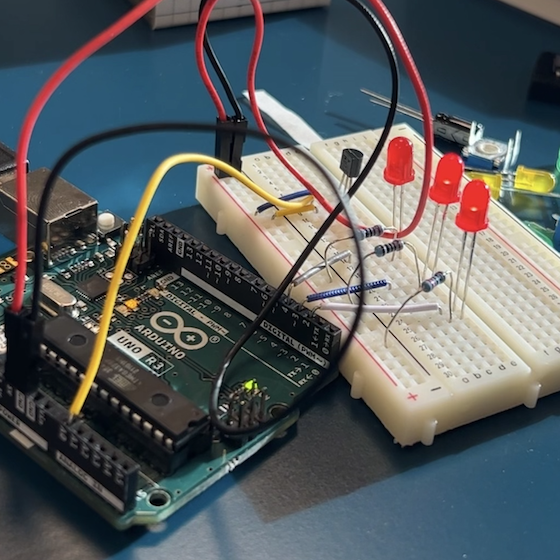
An interesting way of data collection
Data is simply an attempt at representing a phenomena, and there are so many fluctuations and things going into it. It can prove valuable for research; for example temperature data can be used to map and compare space, and how that relates to where light may fall in a room.
Skills and hardware is needed for use of Arduino
It is worth noting that to collect data about our bodies through this hardware, for example, we need technical knowledge and the understanding of how to make sense of it. Grappling to understand how an Arduino works in its various capacities was a lot to begin with, however after unpicking with my peers, it began to slowly make sense. I am aware that my education level resulted in my quick understanding though, and I argue that the cost of Arduino makes it a less accessible method of digitally-driven research in comparison to a free web scraper, for example. With that said, though, creating sensors with hardware like an Arduino allows for different types of research that otherwise we couldn't collect data about with something such as a web scraper. Some of these include facial / AI recognition, light detection (for example, when light hits, there might be an instruction to carry out x activity), and as an accelerometer. Just as with other digital methods, we should always consider potential errors and computation.